Woke up real early, watched the Socceroos get pumped by Germany, went back to bed. That's all I really want to say about today. Of course I wont just say that only, I can't stop talking and typing and talking aren't that far apart. The thing I am missing right now is the discipline of learning. It hasn't even been a week and I am missing the Liberal Christian Arts College I go to. I have a book on the dialogue between Hans Urs von Balthasar and Karl Barth. I was reading it two days straight when I was in the air of college and now I am at home for four days straight I haven't opened it at all.
I like this book, I like the things in it. The push and pull of ideas between Barth and Balthasar over the correct use or misuse of the analogy of being is stunning. The fact that even after Barth has explained his reasons for not accepting the analogy of being (that creation mirrors the creator) Balthasar still continues to find a way to reconcile Barth to the use of it.
Its kind of interesting seeing Balthasar trying to win a Catholic convert in Barth. Its interesting because of the next bit of the Gospel of Mark that I will be speaking on. Its Mark 2:23- 3:6. Okay how does Jesus correcting the Pharisees about their legalistic views on the sabbath? Well it does in the fact that like the Pharisees and pretty much every religion Barth has found a sticking point between himself and the Catholic overuse of the analogy of being. The use of analogy of being was huge it was considered essential to the faith. To Barth it was a horrible thing and he couldn't stand for it to be given such a high regard. Such use of the analogy of being stopped Barth ever seeing himself ever becoming Catholic. A similar point could be made of Luther, Wesley and every other leader who started his own church because others did not hold to the same articles of faith, or ways of mission, or gifts of the spirit.
Its like an episode of The Big Bang Theory with Sheldon being Barth and Leonard being Balthasar (don't ask me who Penny is). Its like when as a six year old I decided that Beatrix Potter was wrong in calling Peter Rabbit's third sister Cottontail. I was adamant that Beatrix Potter had broken the rules of rhyme and it must be - Flopsy, Mopsy and Bopsy. So adamant was I that I named my dog Bopsy.
So adamant were the Pharisees that the sabbath was sacred and holy that the Disciples should not have taken wheat to eat. So holy was the sabbath that Jesus healing a man's withered hand was an absolute outrage. So adamant was Luther that he broke from the Catholic church, the same for Wesley in his split from the Church of England.
So adamant we are when the patterns of our lives are disturbed in ways that are not wrong except that they are not what we see as the right way of doing things. God rested on the sabbath, why? Because he done all he wanted to do, not because it was the sabbath and according to the doctrine of the almighty he had to. Being humans we see patterns and some of these appear regular, solid, dependable, constants. The sun rises and sets, people live and die. But then there are others that we can take as constants. Whose ever had to drive on the other side of the road? That's gotta be disturbing you've driven on the left side of the road all your life and now you have to drive on the other side of the car AND the other side of the road. All of the sudden the pattern is changed what you thought was the way to drive is now something different. Its still driving but it is driving in a whole new way.
Now how are we going to act when God tells us like Jesus did to the Pharisees that we need to change how we live our life with him. That our way of thinking about God is too stiff and rigid that it needs to expand and grow. That our idea of what church is supposed to be is too rigid and we don't see the way he does. That life as a follower of Jesus is not the prosperity you had been promised but that when Jesus says "Take up your cross and follow me" he meant it.
The Pharisees got a shock that day and they responded in anger and fury. How will you respond? With anger, apathy, indifference, defiance. Or will you say to God "Fair Cop" you're right I have been doing this the wrong way. Change is hard and its even harder when we resist please don't resist submit. Humble yourself before the Lord and he will lift you up.
Sunday, June 13, 2010

Thursday, June 10, 2010
Journal - June 11 2010
Its 2 days in a row now and that's a good thing. I spent yesterday making the first part of what has become a 2 part piece on youtube.
Its about the Christology essay I did, which was on Holy Saturday. You know the day between Good Friday and Easter Sunday? Yeah that day and what did Jesus do on that day?
 He could have been playing cards for all most people know. In fact there is not that much written about it at all. Even in the bible there is less written about what Jesus did in the grave than anything else. Which makes any thinking about Holy Saturday a struggle.
What also makes for more problems is the Apostles Creed and the line - "He descended into Hell" - which brings a range of responses. Mostly I don't know or I'm not sure about that. For me it was a complete empty hole of a day and the whole concept of Jesus descending into Hell was something I had never thought of. Of course now I have thought about it, read about it, and have come to a point of understanding that is not heretical but its certainly not traditional.
The traditional understandings are mentioned in the video and are garnered from a couple of verses in the bible (most taken out of context) and the not so well known gospel of Nicodemus. This scant information being embellished into the fantastic and mythical is a main point of those who wont have it. Yet it is such a silent hole in the Easter story that its silence calls to many to work out what is happening. Honestly I hear it calling out to me and its really hard not to think about this everyday now.
The only real advancement beyond the dogma and confessional beliefs of the churches comes from Hans Urs von Balthasar. For Balthasar the silence of Holy Saturday calls out to him to such an extent that he makes it the center of his Christology. Solidarity is the big word for Balthasar, Christ's Solidarity with the living when he is alive and Christ's solidarity with the dead when he is dead. That's where I end the first part, Christ dead in Hell. Which is incredibly confronting and sad, it is hard to think of Jesus the Son of God dead for any moment of time. Yet the solidarity that Balthasar talks of seems true in the way he explains it. It is in the living out of humanity in its fullness and perfection that Jesus is in solidarity with us. This is also true in the death of Jesus as we die and wherever we go after death Jesus goes to the dead.
What arises out of this solidarity with the dead is much the same as his solidarity with the living. It is the same solidarity just in a different point in the Human Trajectory (Birth, Life, Death, Going to the Dead). There is nothing extra added to salvation by Christ going to the place of the dead it is a part of his whole redemption of humanity. No extra salvation is possible because on the Cross "It is finished".
Despite this others have taken Balthasar's solidarity of the dead Christ with the dead to be a salvation for those in the place of the dead with Christ. A salvation that takes up Hell into Heaven so all is redeemed, this is called Universalism and its got it wrong. The unfortunate thing about such a false hope is that they haven't seen the consistency of the exclusive/inclusive offer of salvation. Not all of those who live are saved by Christ's solidarity with the living only those who decide to admit, submit and follow Christ. It is not Christ's solidarity with those dead with him, it is Christ's solidarity with those who are DEAD IN CHRIST. There is time to make our decision while alive after live there is no second chance. The unfortunate result of this is that those we knew who have passed away without deciding for Jesus is that they are lost.
When you strip away the veil of myth and fantastic there is actually more to Holy Saturday than an action movie. We have God in the form of Jesus dead in the place of the dead, in our place. Redeeming us from the righteous punishment that we deserve. He is silent and passive just like the rest of the dead, yet his preaching is his witness that here in the depths of dispair God has come to put everything right again.
Its about the Christology essay I did, which was on Holy Saturday. You know the day between Good Friday and Easter Sunday? Yeah that day and what did Jesus do on that day?
 He could have been playing cards for all most people know. In fact there is not that much written about it at all. Even in the bible there is less written about what Jesus did in the grave than anything else. Which makes any thinking about Holy Saturday a struggle.
What also makes for more problems is the Apostles Creed and the line - "He descended into Hell" - which brings a range of responses. Mostly I don't know or I'm not sure about that. For me it was a complete empty hole of a day and the whole concept of Jesus descending into Hell was something I had never thought of. Of course now I have thought about it, read about it, and have come to a point of understanding that is not heretical but its certainly not traditional.
The traditional understandings are mentioned in the video and are garnered from a couple of verses in the bible (most taken out of context) and the not so well known gospel of Nicodemus. This scant information being embellished into the fantastic and mythical is a main point of those who wont have it. Yet it is such a silent hole in the Easter story that its silence calls to many to work out what is happening. Honestly I hear it calling out to me and its really hard not to think about this everyday now.
The only real advancement beyond the dogma and confessional beliefs of the churches comes from Hans Urs von Balthasar. For Balthasar the silence of Holy Saturday calls out to him to such an extent that he makes it the center of his Christology. Solidarity is the big word for Balthasar, Christ's Solidarity with the living when he is alive and Christ's solidarity with the dead when he is dead. That's where I end the first part, Christ dead in Hell. Which is incredibly confronting and sad, it is hard to think of Jesus the Son of God dead for any moment of time. Yet the solidarity that Balthasar talks of seems true in the way he explains it. It is in the living out of humanity in its fullness and perfection that Jesus is in solidarity with us. This is also true in the death of Jesus as we die and wherever we go after death Jesus goes to the dead.
What arises out of this solidarity with the dead is much the same as his solidarity with the living. It is the same solidarity just in a different point in the Human Trajectory (Birth, Life, Death, Going to the Dead). There is nothing extra added to salvation by Christ going to the place of the dead it is a part of his whole redemption of humanity. No extra salvation is possible because on the Cross "It is finished".
Despite this others have taken Balthasar's solidarity of the dead Christ with the dead to be a salvation for those in the place of the dead with Christ. A salvation that takes up Hell into Heaven so all is redeemed, this is called Universalism and its got it wrong. The unfortunate thing about such a false hope is that they haven't seen the consistency of the exclusive/inclusive offer of salvation. Not all of those who live are saved by Christ's solidarity with the living only those who decide to admit, submit and follow Christ. It is not Christ's solidarity with those dead with him, it is Christ's solidarity with those who are DEAD IN CHRIST. There is time to make our decision while alive after live there is no second chance. The unfortunate result of this is that those we knew who have passed away without deciding for Jesus is that they are lost.
When you strip away the veil of myth and fantastic there is actually more to Holy Saturday than an action movie. We have God in the form of Jesus dead in the place of the dead, in our place. Redeeming us from the righteous punishment that we deserve. He is silent and passive just like the rest of the dead, yet his preaching is his witness that here in the depths of dispair God has come to put everything right again.
Wednesday, June 9, 2010
Journal - Online edition June 10 2010
Thought I would use this blog again as a place to begin journaling online. Not because I have a huge ego and require the world to see my thoughts because they are amazing and important - because I do have a big ego and what I have to say is amazing and important to the world. Ego aside... Having woken up on the first day of what is the mid-semester break from the liberal not so conservative Christian Arts College that I attend. I need to begin what I see as essential disciplines required to survive the break.
Last year I got through my first semester and I just dropped out emotionally, socially and spiritually. Physically I was fine I kept playing Soccer, but outside of that I isolated myself like the UNA bomber. I kept to myself and barely saw anyone at all for the first half of those eight weeks, yeah 8 weeks. So this mid-semester break things are going to have to be different cause I am not going back to that again. The key to this is accountability and making sure that friends and family know what happened and working out what activities I should be doing on a daily basis. Journalling or blogging here is a start.
What else can I do to stop bottoming out? Well I have a small cache of canvass frames ready to be painted on which is a start. The unfortunate thing about that is that its winter here in Australia, and I haven not yet found a place to paint. "Do it inside." I hear you say. Well, with a rented house and a very messy painting style that uses aerosol spray cans I do not see the landlady being all that happy. Reading - now that is a good idea and I do have a small supply of books that I want to read, but TV gets in the way of that sometimes. Movies that I missed? maybe not everyday but if I make one night movie night then and invite people over that would be a great idea.
Work? Well that is good to and if it pops up then great. Youtube videos on the theology that I have learned this semester would be a great thing and I have already proven I can make a 2-3 minute youtube video. I have a possible collaborator but unfortunately he does not have a mac, so he has to find a way to shoot and edit his movies with a camera and pc software.
Okay the dog needs to be walked and I need to get out of the house.
Last year I got through my first semester and I just dropped out emotionally, socially and spiritually. Physically I was fine I kept playing Soccer, but outside of that I isolated myself like the UNA bomber. I kept to myself and barely saw anyone at all for the first half of those eight weeks, yeah 8 weeks. So this mid-semester break things are going to have to be different cause I am not going back to that again. The key to this is accountability and making sure that friends and family know what happened and working out what activities I should be doing on a daily basis. Journalling or blogging here is a start.
What else can I do to stop bottoming out? Well I have a small cache of canvass frames ready to be painted on which is a start. The unfortunate thing about that is that its winter here in Australia, and I haven not yet found a place to paint. "Do it inside." I hear you say. Well, with a rented house and a very messy painting style that uses aerosol spray cans I do not see the landlady being all that happy. Reading - now that is a good idea and I do have a small supply of books that I want to read, but TV gets in the way of that sometimes. Movies that I missed? maybe not everyday but if I make one night movie night then and invite people over that would be a great idea.
Work? Well that is good to and if it pops up then great. Youtube videos on the theology that I have learned this semester would be a great thing and I have already proven I can make a 2-3 minute youtube video. I have a possible collaborator but unfortunately he does not have a mac, so he has to find a way to shoot and edit his movies with a camera and pc software.
Okay the dog needs to be walked and I need to get out of the house.
Sunday, March 7, 2010
Short Version - With Pictures...
The Challenge of Jesus
N.T. Wright 1999
Chapter 1 – The Challenge of Studying Jesus
Where to start well why not with the word that Wright repeats – necessary. The whole chapter is Wright imploring and explaining why the “Quest for the Historical Jesus” is important not just to the historians but to Christianity as a whole.

How is it important? Well there was a guy called Martin Luther and he did some research on this translation which came up with “do penance” Martin's study realised that it was “repentance” big difference between these huh! Of course the changes that came from this and Luther's other work were somewhat extensive. Wright alludes to the possibilities for not just individuals but for Christianity as a whole when research takes place.
Yet in my experience such historical research usually brings results from people who are trying to refute Jesus existence or that he was less than the Son of God. Either that or it is extreme in the other direction that Jesus was some hologram projected by God not a human but a super-human.
Why do we have this split not just between believers and unbelievers but within Christianity itself?
Historically what has happened is detailed by Wright in his belief that asking the question “Who was Jesus and what did he accomplish?” is necessary, but the way in which it is asked is what results in the answers that we have read in shock or dismay. Wright points to the Enlightenment and specifically to Herman Samuel Reimarus who asked the question about Jesus to try and prove that Christianity is merely a mistake. It is from the Enlightenment that the current situation stems from, its separation of fact from faith by elevating human reason changed the playing field. Jesus was either a simple peasant cynic or a superman. This is a generalisation but it is the effect of the Enlightenment and its belief that the main event of human history was in the eighteenth century and not the events in the first concerning Jesus of Nazareth that were the main event (a rival eschatology - asserts Wright).

Because of the resulting answers coming from the question responses were either for or against and the effect of the enlightenment's split between fact and faith is seen in the divide between liberal and conservative. Despite all of this Wright says that the question asked by Reimarus and the Enlightenment is “necessary” and Wrights reasons are as follows.
God – To ask questions about Jesus and discuss him is to be discussing God. We learned last week in Ogden that any question about Jesus is a question about God as well as a question about who we are (the existential question)
Loyalty to Scripture – If we believe the bible then we should be making sure that we understand it in the context that it is set in. Imagine what people will make of LOL or ROTFLOL in two thousand years time.
Truth – We should not be afraid of the truth and what it actually is and the possible changes that can and will occur when you delve deeply into the question “Who is Jesus and what did he accomplish?” Did you watch compass last sunday night? It was disturbing hearing this message that I thought I was okay with that Jesus was (and is) a Jew. This exploration may freak us out but if we believe “The way, the Truth and the Life – it is Jesus” then why should we be afraid
Commitment to mission – We can answer the questions that will come to us from those who believe as well as those who are trying to find the evidence that it is all a sham. If we know the information and the history surrounding Jesus and the first century we can answer these people. There's that joke on the Vicar of Dibley “Have you read the new book of the bible, you know the Da Vinci Code.”

Wright finishes explaining the situation or state of play as he sees it of the quest. The quest came about from a question that was necessary but asked in the wrong fashion, since then there have been three main streams within the quest headed by Wrede, Schweitzer, and Kahler.
Wrede is the sceptic “we cannot know very much about Jesus, he certainly did not think of himself as the Messiah or the Son of God and the Gospels are basically theological fiction.”
Schweitzer – the middle of the road believing that Jesus being a First century Jew had similar understandings about the end times and how they would come about. Also that the Gospels got Jesus character right.
Kahler – Saw that the quest was just a way for historians to imagine up stuff about Jesus.
Wright places himself in the middle ground of course yet he continues to explaining that we cannot just discount the arguments that are put by those we consider to be wrong. That only in joining the quest and producing arguments that lead to theories that disprove them that we can correct them.

It is because of these reasons and the growth that can come from this quest that Wright is pushing it so hard. That this should never be considered a finished work, that the previous generation worked it all out before. Wright believes that every “generation has to wrestle afresh with the question of Jesus” I agree.
If you want to read my long version it can be found at my blog -
http://thischristianguy.blogspot.com/2010/03/tutorial-presentation-challenge-of.html
http://vialogue.wordpress.com/2008/12/25/the-challenge-of-jesus-notes-review/
http://www.gracecathedral.org/forum/for_20060514.shtml – Wright with Anne Rice 2006
Other stuff I found its interesting to read.
Tutorial Presentation - Long version
Tutorial Presentation
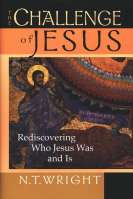
N.T. Wright 1999
Chapter 1 – The Challenge of Studying Jesus
First and main issues is described with the Kenyan students and the German scholars loosing (?) Jesus
Wright uses the words “vitally necessary” to describe the historical quest for Jesus, not to say that the knowledge that of Jesus that is common within the history of the church is wrong or inaccurate. It is necessary so that we may be able to “get to know even better the one whom we claim to know and follow”
Despite this being “necessary and nonnegotiable” that this can bring out a deeper understanding of the Jesus who we follow there are dangers.
There are extremes who are for this quest and against it. There are those who by asking the questions of “Who Jesus is and what did he accomplish?” that seek to expose Christianity as a big misunderstanding. The unfortunate result of this is that Christians have often looked at such historical study and only seen the extremes. Jesus was a New Age guru or a Peasant cynic. Of course you can go to the other extreme and see those who see Jesus as a “First Century Super man” which is just as destructive.
Of course both extremes view each other with a level of disdain considering their view much more superior. These extremes are not what Wright is on about, where Wright sees this quest should be is somewhere in between this divide between fact and faith. That we can search for Jesus and find him historically in a way that will compliment our understanding.
So from the negatives Wright then talks about the positives giving the reasons for this quest.
“that we are made for God: for God's glory, to worship God and reflect His likeness.” In discussing Jesus we are also discussing God. Whatever we can learn about Jesus will give us an understanding about God. As we learned from Ogden last week the question “Who is Jesus?” also asks “Who is God?” as well as “Who am I?”
Loyalty to scripture we should learn as much as we can about the situation in the first century so we are able to understand the context of what is said in scripture. (Imagine what debates historians will have in 200 years time wondering what LOL ROTFLOL and meh are?) If there is anything that can aid in a closer understanding of the things we take right now as traditions and whether they are biblical or not will aid us. It aided Martin Luther.
Truth. What the gospel truly means in its original setting. That understanding the meanings even more deeply effects how you see the truth of the gospel. We believe that is the truth about Jesus who said as we learned from Ogden last week “The way, the truth, the life, I am it.” Thats just one piece that we only recently learned and that was an eye opener for me. What more could we learn.
The final one rolls back into the intellectual conflict with historians trying to prove that Christianity is a mistake. Knowing the truth of the history of the first century we will be able to explain when the next Da Vinci Code comes out. What do you do when you get the Vicar of Dibley joke – Have you read the new book of the bible? Yeah you know, the Da Vinci code.”
Christianity has to be rooted in the first century happenings of Jesus in Palestine then its all hooey. The sceptics should be answered and in answering this by examining the history of our beliefs which once interpreted correctly (Christmas anyone?) will bring “depths of meaning within them that we had never imagined”
Earlier I looked a bit forward into this chapter and mentioned the divide between fact and faith, this is explained by Wright as happening within a time known as the Enlightenment. I like to call it the En-darkenment cause a lot of the issues in and around Christianity today stem from this period of thinking. Wright describes this as the Enlightenment “asking a question in a misleading fashion”. Because of the results of asking the “Who was Jesus and what did he accomplish?” in the Enlightenment's way resulted in things like the Jefferson Bible and that Jesus was only a liberal speaker ahead of his time and so on. This freaked out the Christian establishment and developed a bit of a suspicion of the intellectual community.
Wright goes into detail describing this history (while apologising that he is not an eighteenth century historian) in which the Enlightenment started asking questions of the Christian dogma which had been static for sometime not continuing in the historical quest that could have offered a defence. So when Herman Samuel Reimarus came about with his Christianity is based on mistake it caused heaps of trouble. It is here that the necessary's come back from Wright, beginning that Reimarus's question was necessary to shake the “bland dogma” and it was not the first time that it was needed. Perhaps it is needed again now. So when the historians come up with facts that you do not agree with about Jesus perhaps we need to go and find out about it ourselves.
In what I see as decisive point to the issues detailed earlier in the challenge of and historical search for Jesus, Wright explains that it was the Enlightenment that split fact and faith. This split exists today on liberal and conservative boundaries. Yet the Enlightenment offers more than a way to think but a rival Eschatology to Christianity. They thought the light or reason and logic in human thought in Western Europe and America in the Eighteenth century. What came before was dark compared to the light of this new Enlightenment. You cannot use this thinking to explain Christology because if the Enlightenment the big moment then what happened in Palestine in the first century was not. So Jesus was brought down to being either good moral teacher or a superman not what he is, the Son of God who come into the world to be a man to live and die and rise again.
Now comes the resurgence of the quest which begins with Albert Schweitzer who pointed to the first century Jewish context of the world in which Jesus lived. It was the study of Schweitzer about the historical Jesus and the first century context in which he lived that convinces Wright that such study should continue and if it does there will be more understanding.
Despite such a search into fresh understanding of the contexts within the bible as Wright implores coming up with fresh and new ways to address the questions of the historical Jesus, there are negatives this way. Because of the history of the christianity and its errors on the conservative and modernist side there are errors in the other way. Seeing Jesus as a demigod untouched by human problems and secret ways to escape this world or this reality. This secret knowledge or Gnosis can be a result of a search for Jesus which takes things further away from the truth in the other direction.
Is there anything new to say about Jesus? Wright suggests yes and no. Jesus did announce the arrival of the Kingdom of God but “What did Jesus mean by the kingdom of God?” I'd like to ask what did Jesus mean by “fishers of men” was this a colloquial saying? We can ask these questions now and expect to find information because there are so many new sources to use. The Dead Sea Scrolls and a lot of historical information on the Pharisees and the Roman agendas of the time. We know a lot now. There is so much that more can be discovered about the time when Jesus was on the planet and if we believe that Jesus is the Word of God made flesh then what we learn should go into understanding the Gospels and Christian tradition as to what needs to be kept and what needs to be removed. Martin Luther did this and the results of this are the rediscovery of “repentance” instead of the mistake “do penance” which was then morphed into a individual and pious understanding not a giving up of your whole a way of life. More than just a change of heart.
This shows us that the Gospels are not to be thrown out but that the research needs to used to weigh and challenge the meanings we have known and cherished. Its a quest that needs to be done by all parts of the church (what even the evangelicals?)
History of the quest (the good stuff and the bad stuff)
State of play in the Quest for the Historical Jesus is (in Wrights view) held in three camps headed by their historical questing forbears. Wrede, Schweitzer, and Kahler
Wrede – sceptic, we cannot know much about Jesus and he never said he was the messiah. So the Gospels are fiction.
Schweitzer – Jesus lived in first century Palestine and had the same “apocalyptic expectation” he died without it coming about. Jesus started the eschatological movement that became Christianity. Oh! And the Synoptic Gospels got Jesus right.
Kahler – God said it I believe it that settles it. The bible and faith only not the imagination of historians.
From these three come the current movements within the quest, Wright considers himself within the Schweitzer camp. There is a history that is stilted when it comes to the quest with certain individuals making steps forward while others were merely piecing together small but supposedly authentic isolated sayings.
From here Wright goes on to explain that it is not enough to disagree with those who have opposing opinions because they are wrong in asking such questions but to argue the point not just them as foolish liberals or conservatives. To come up with an “alternative hypothesis” that gives a simple solution to the problem. - Challenge to those who want to begin throwing stones at each other, don;t just throw stones do the research and throw hypothesises.
Wright ends with a challenge to the church not to just to leave it to the bible boffins to come up with these new understandings. That the answers are not all found and thought of before, it is not as complete a picture as we thought it was. Wright advises that - “each generation has to wrestle afresh with the question of Jesus” that this is a task for the whole church especially the leaders and teachers. It is difficult but Wright points to the understanding and deeper knowledge that can come from such a quest, understanding that could grant us a new vision “not just of Jesus, but of God”
Saturday, February 20, 2010
More on Immediately Mark 1:17-18
Okay, enough with the predestination questions and the calvinist versus arminianist debate which will continue till Jesus returns and settles it. I want to get back onto immediately.
immediately
• adverb 1 at once. 2 very close in time, space, or relationship.
At once, right now, instantly, this second. There was no hesitation for Simon and Andrew in following Jesus call. What does that say about Jesus? What did he have that brought this reaction in people? It wasn't the last time this happened, we can see it in the call of Levi, we can also see it in other who followed Jesus.
I really don't know what I'm trying to get to here. It almost feels like I'm scrapping a barrel that is too deep for me too reach to bottom of. I want to reflect on the immediately that is the calling of Simon and Andrew. The fact that James and John left their fathers behind with the employees. The whole rabbinical style of teaching that was going on at the time. The beliefs on the coming of the messiah and John the Baptist and Jesus and the beginning of Jesus ministry.
There is just so much in here that I am not sure what to exclude. If I try to have all of this together can I make it straightforward enough for people to follow me.
At first I was thinking about the calling itself and the "immediately" response of the men called. I was looking at working on who is this Jesus guy and what powers of speech did He have to do this. Was he a hypnotist, a charlatan, a conman, a leader of men. I was meaning to compare Jesus to certain political figures, also great speeches from movies like Henry V, and Braveheart. I was going to lead into the who Jesus is to be able to do this? What makes Him so special? What does he have to be able to command such a response from 4 guys who leave everything they have known to follow Him?
It looks like I have to weed out the rouge thoughts from the immediately.
Friday, February 19, 2010
"Follow Me" He said, and they did.
17And Jesus said to them, "Follow Me, and I will make you become fishers of men."
18Immediately they left their nets and followed Him.
Mark is brief on the details when it comes to the calling of Simon, Andrew, James and John. It includes less than both Matthew and Luke (Luke of course including the most detail in this event), yet this is the core moment. Jesus calls and they immediately follow. No hesitation, no pause, no talking to their father, mother, wife, girlfriend or life coach. Four guys who have been in the fishing business all their lives (it mentions in Mark that James and John left their Dad with the hired help) it wasn't their lot in life to follow some wandering Rabbi. At least that is how it looks like.
Questions bubble up in my mind about this immediate decision to follow Jesus. Of course being a christian I know that the calling of Jesus the Christ is irresistible. Yet how do I explain this calling? How did Simon, Andrew, James and John answer it? Immediately. It is not a decision that you can take and leave in the back of your mind, or is it? Also, can someone who has decided to follow Jesus leave?
Subscribe to:
Posts (Atom)